

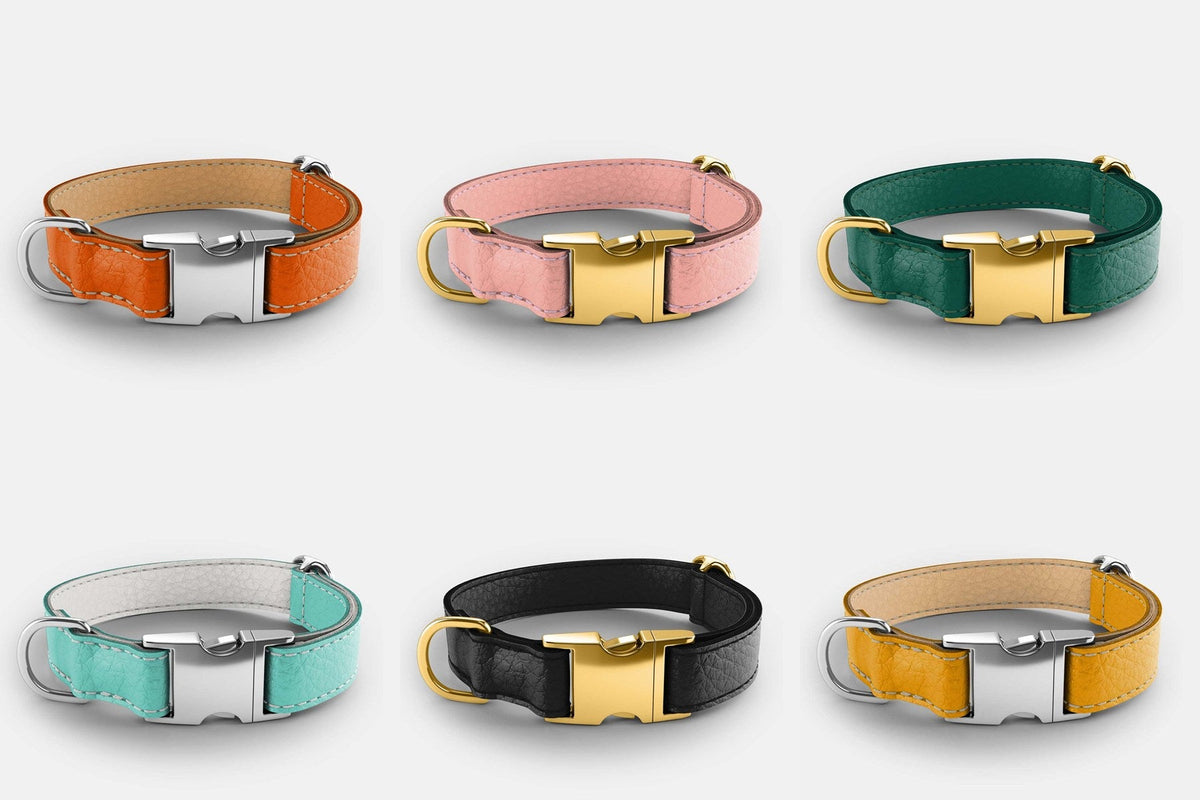
A good leather dog collar fits a bit like a watch strap: snug enough to stay where it should, loose enough that neither of you notices it. Getting there is mostly a matter of measuring properly, so that is where this guide starts. After that comes which size and width to choose, when a harness makes more sense, and how to keep the leather looking good after a winter of muddy walks.
The short version
- Measure around your dog’s neck where the collar sits, snug but not tight.
- Choose the size whose range includes that number. If you are between two sizes, go for the larger one.
- Check that two fingers slide flat under the fastened collar.
- Dogs that pull are usually better off in a harness, with the collar kept for the ID tag.
- Look after it with a damp cloth and slow drying. Rain is fine; a swim is not.
How to measure your dog for a collar
Use a soft tape measure. A piece of string and a ruler will do the job too. Wrap it around the middle of the neck, where a collar naturally sits, rather than down at the base where the neck meets the shoulders. Keep it snug but not tight, and read off the number. That is the size you are shopping for.
Two tips. On a fluffy dog, press the tape through the coat rather than resting it on top. And measure a wriggly dog twice, because the first number is usually wrong.

Leather dog collar sizes
Our collars come in three sizes, and each one adjusts across a range:
| Size | Neck size | Width | Weight |
|---|---|---|---|
| Small | 19 to 29 cm (7.5 to 11.4 in) | 1.5 cm | 50 g |
| Medium | 28 to 44 cm (11 to 17.3 in) | 2 cm | 75 g |
| Large | 39 to 65 cm (15.4 to 25.6 in) | 2.5 cm | 110 g |
The ranges overlap on purpose. If your measurement fits two sizes, choose the larger one: you get more room to adjust, and a collar that sits in the middle of its range is more comfortable than one pulled to its limit. A 42 cm neck, for example, fits both Medium and Large, and Large is the better choice.
As a rough guide, toy breeds and young puppies usually start in Small, most medium sized dogs land in Medium, and big breeds such as Labradors and Huskies need Large. The Husky in our photos wears a Large. Necks vary as much as dogs do, though, so trust the tape measure over the breed.
A collar costs £35 in Small, £46 in Medium and £54 in Large, and you will find every colour in our leather dog collar collection.
The two finger rule
Once the collar is fastened, you should be able to slide two fingers flat between the leather and your dog’s neck. If you cannot, it is too tight and will rub. If your whole hand fits, it is loose enough to slip over the head on a walk, which is exactly the moment you least want it to.
Check the fit again after a trip to the groomer, when a thick coat suddenly becomes a thin one, and every couple of weeks while a puppy is growing.
How wide should a dog collar be?
Width matters as much as length. A wider collar spreads any pressure across more of the neck, while a narrow one keeps things light for a small dog. That is why our widths grow with the sizes: 1.5 cm for Small, 2 cm for Medium and 2.5 cm for Large. The Small weighs 50 g, about the same as a small egg.
Our leather leads follow the same widths and are all 125 cm long, so a collar and lead in the same size and colour make a matching pair. The leads are not adjustable, which is why they come in three sizes too.
Collar or harness?
A collar is for everyday wear and for carrying your dog’s ID tag. A harness takes the strain across the chest instead of the neck, which makes it the better choice for dogs that pull, for flat faced breeds such as French Bulldogs and Pugs, and for some puppies. Plenty of owners use both: the collar stays on with the tag, and the harness goes on for walks.
To size a harness, measure around the chest just behind the front legs, where the harness naturally sits. Our leather harnesses fit chests of 30 to 43 cm (Small), 45 to 66 cm (Medium) and 58 to 89 cm (Large), and the same rule applies: if you are in between, go larger.

Can a puppy wear a leather collar?
Yes. A puppy can wear a collar from about eight weeks old, and our Small weighs just 50 g. Start with short spells so your puppy gets used to the feel, check the two finger rule often, and be ready to move up a size, because puppies grow faster than anyone expects. For flat faced breeds, a harness may suit better from the start. Your breeder knows the breed best, so it is worth asking them too.

Where to hang the ID tag
In the UK, the Control of Dogs Order 1992 requires a dog in a public place to wear a collar with the owner’s name and address on it, either on the collar itself or on a tag attached to it. A phone number is optional, but sensible.
Hang a heavier metal tag on the slider rather than the D-ring. A tag swinging from the D-ring knocks against the buckle all day, which scratches the hardware and wears it out faster. On the slider, it sits quietly.
How to look after a leather dog collar
Our collars are made from soft, full grain Italian leather, and they cope with British weather better than you might expect. Rain is fine, and the metal buckle is sealed against rust. What they should not do is go swimming. Take the collar off before a bath, the sea or the duck pond, and put it back on only once it is dry.
If it does get soaked, pat it with a towel and let it dry naturally at room temperature, away from radiators and log burners. For everyday dirt, a clean damp cloth is enough. Let mud dry first and brush it off, rather than smearing it in. Now and then, a little leather protection cream after cleaning keeps the leather supple.
Two more things. A leather collar is not a chew toy, however convincing your puppy’s argument. And if your dog has a metal allergy, our hardware is a zinc alloy, and the full composition is listed on our harness pages.
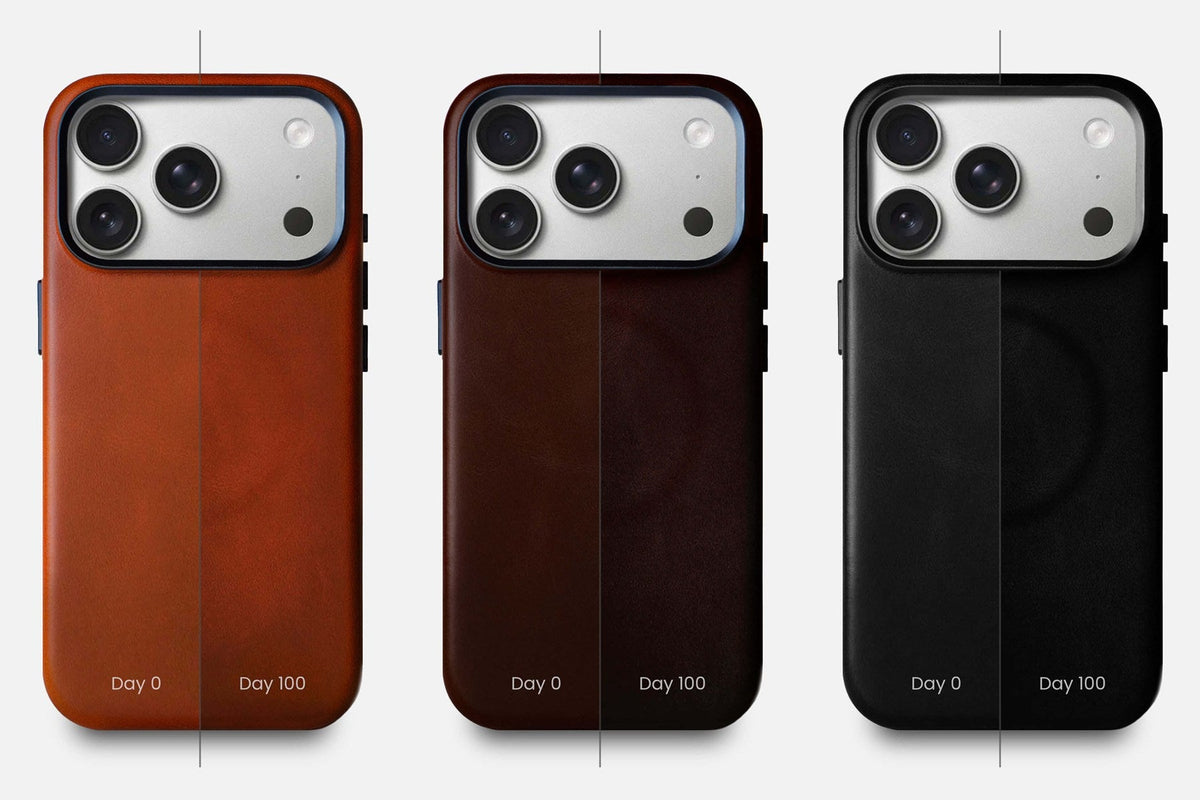
Leather changes with use, and a few marks are part of the deal. We wrote about why that is a good thing in why leather still matters, and most of what we say about cleaning a leather phone case applies to a collar too.
Colours and matching sets
Our collars come in 11 colourways, most of them in two tones, with silver or gold coloured hardware depending on the colour. Pumpkin Orange and Beige is the most popular, Black is the quiet one, and Light Blue and Off-white is the one that gets noticed in the park.
Every colour has a matching lead, and most have a matching harness too. It is all in our leather dog accessories collection. A collar and lead in the same colour also make a very good present for a dog owner, and there are more ideas in our guide to leather gifts. And if you like matching so much that you want it for yourself, here is how to pair your own case, strap and AirPods case.
Frequently asked questions
What size collar does my dog need?
Measure around the middle of the neck, snug but not tight, and choose the size whose range includes that number: Small 19 to 29 cm, Medium 28 to 44 cm, Large 39 to 65 cm. If you are between two sizes, choose the larger one.
How tight should a dog collar be?
Tight enough that it cannot slip over the head, loose enough that two fingers slide flat underneath. Check again after grooming, and regularly while a puppy is growing.
What are your dog collars made of?
Soft, full grain Italian leather with stitched edges, and zinc alloy hardware in silver or gold tones.
Can a leather dog collar get wet?
Rain is fine, and our buckles are sealed against rust. Do not let it go swimming, though: take it off for baths and the sea, and if it gets soaked, let it dry naturally at room temperature.
Is a collar or a harness better for a dog that pulls?
A harness. It takes the pull across the chest instead of the neck. Many owners keep a collar on for the ID tag and clip the lead to the harness.
Keep reading
Why Leather Still Matters in a Fast Moving Digital World
The Art of Giving: Premium Leather Gifts That Combine Style and Function

Leave a comment
This site is protected by hCaptcha and the hCaptcha Privacy Policy and Terms of Service apply.